Mobile phone: 18815239758 (same as WeChat)
Phone: 0576-89881178
Phone: 0576-89825885





The first step in secondary gas pressurization is to understand the operating conditions that require pressurization. Here are a few simple examples to avoid taking unnecessary detours: 1. What medium is being pressurized? (Some media with special properties, such as gaseous carbon dioxide, have low temperatures and are prone to enter the supercritical point. When the pressure is increased, it is easy to form dry ice, and so on, which requires the use of Feentor CO2 gas specific pressurization equipment.).
READ MORE
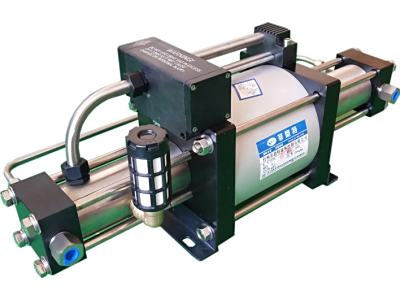
The butane booster pump is a piston reciprocating booster pump powered by compressed air. The reciprocating switching of the pump is controlled by the pneumatic directional valve on the booster pump. When the output pressure increases, the reciprocating operation of the butane pump will slow down until it stops. At this time, the air consumption of the booster pump is the smallest. When the pressure is unbalanced, the fixed pump will continue to operate in a reciprocating manner.
READ MORE
The blasting test bench is a destructive test conducted on certain pressure bearing parts, pressure vessels, and pipelines after production, based on the product's pressure resistance limit value and pressure characteristics. It is generally divided into two methods: hydraulic blasting test and pneumatic blasting test.
READ MORE
Liquid booster, also known as liquid booster, gas-liquid booster valve, gas-liquid booster, water pressure booster pump, etc., is based on the proportional relationship between the driving piston and the hydraulic piston area. It controls the reciprocating operation of the pump body through a directional valve, and the output pressure is proportional to its driving air pressure. It can be simply understood that liquid booster is divided into three parts: driving part, boosting part, and control part
READ MORE
Let's first understand the structure of a high-pressure pneumatic gas booster pump. The Feentor pneumatic gas booster pump is composed of an air driven reciprocating large-area piston directly connected to a connecting rod and a small area gas piston. Each gas chamber end cap contains an output and input one-way valve, and the air drive section includes a circulation shaft and a guide valve. When the gas is driven by humans, both provide continuous reciprocating motion.
READ MORE