Mobile phone: 18815239758 (same as WeChat)
Phone: 0576-89881178
Phone: 0576-89825885


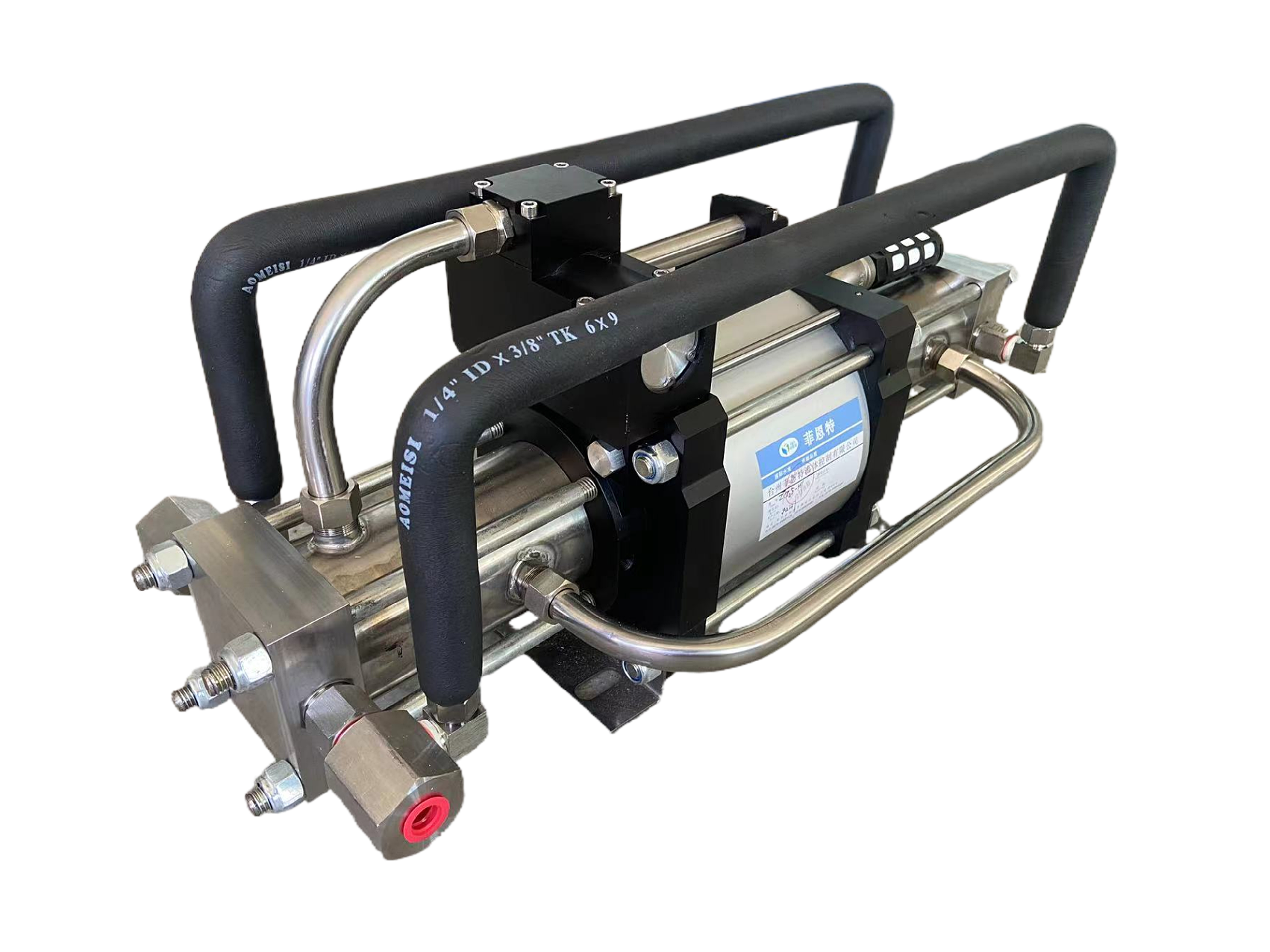
Pneumatic gas booster pump, as the name suggests, is a machine used to boost gas, also known as a gas booster, gas booster pump, booster valve, and gas amplifier. It is generally divided into two categories for gas boosting: electric gas booster pump and pneumatic gas booster pump. Let me introduce the principle, characteristics, and parameters of pneumatic gas booster pump.
The pneumatic gas booster pump is made of aluminum alloy and stainless steel materials, and the pump body is divided into three parts: the driving part, the boosting part, and the reversing part. The pistons at the driving end and the boosting end are connected by a coupling shaft, and the reciprocating operation is controlled by a directional valve. By adjusting the driving pressure to regulate the output pressure of the pneumatic gas booster pump, the pressure of the pressurized gas will affect the flow rate output by the pump body. The pressure range of the driving end is generally (3-8 bar).
Characteristics of Pneumatic Gas Boosting Pump
1. High output pressure, simple pressure regulation (adjusting the drive to adjust the output)
2. Long lifespan and easy maintenance (usually replacing seals is sufficient, customers can also replace them themselves)
3. Widely applicable and highly recognized in the industry (can be used in industries such as increasing pressure or filling and recycling)
4. Strong substitutability (domestic pneumatic gas booster pumps can currently replace imported products from abroad)
5. Widely pressurized media (CO2, nitrogen, oxygen, helium, nitrogen, hydrogen, etc.)
6. Strong applicability, suitable for field operations, etc. It can be used as a driving medium by reducing pressure with high-pressure gas cylinders.
Pneumatic gas booster pump parameters: output pressure range: 0-100Mpa, boost ratio range: 1:1 to 150:1, flow range: (30Ln to 1360ln/min)